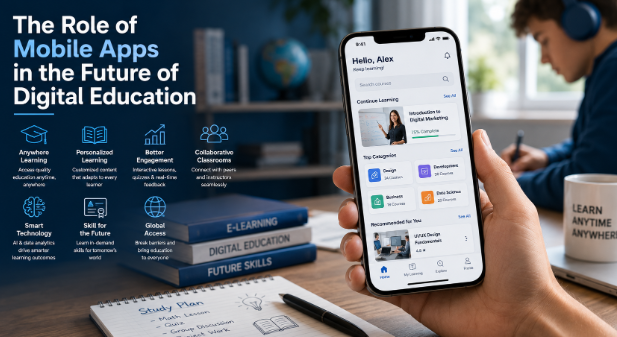
Miriam Osei had been teaching secondary school mathematics in Kumasi for fourteen years when her school district piloted a mobile learning initiative. The pilot was straightforward on paper: students would use a curriculum-aligned application for 20 minutes of daily practice, and teachers would receive weekly progress reports showing mastery levels by topic. Miriam was skeptical in the way that most experienced teachers are skeptical of technology initiatives: she had seen interactive whiteboards gather dust and tablet programs produce more distraction than learning, and she expected this one to follow a similar arc. What she did not expect was what happened in the third week. A student named Kweku, who had been failing algebra for two terms and who Miriam had quietly categorized as a student who needed a different path, scored 94% on a module covering linear equations. When she asked him about it after class, he told her that the application had shown him the same concept eleven times in eleven different ways until the one that clicked for him finally appeared. No classroom had the time for eleven explanations of the same concept. The application did. That moment changed how Miriam thought about the role of technology in her classroom, not as a replacement for what she did but as an infrastructure for doing things her classroom environment structurally couldn’t do. The Mobile App Development Company that had built the application had made a specific product philosophy decision: the application would not teach the way a classroom teaches. It would do the things a classroom cannot, and leave everything else to the teacher. The clearest signal that mobile applications are going to reshape education isn’t the number of edtech companies attracting investment. It’s the Kwebies of the world for whom the right explanation, delivered at the right moment in the right format, was always available. The classroom just couldn’t find it in time.
What Classrooms Cannot Do That Applications Can
The structural limitation of the classroom as a learning environment is time-and-attention scarcity. A teacher with 35 students has, on average, less than two minutes of individualized attention to give each student in a 60-minute period. That allocation is spread across students who are at very different points in their understanding, who respond to very different explanation styles, and who encounter difficulty at different moments in the learning sequence. The constraints are not failures of teaching skill. They are features of the environment.
Mobile applications remove several of those constraints simultaneously. An application can give a student unlimited repetition on a concept they haven’t mastered without social embarrassment or time pressure. It can present the same concept in multiple modalities, visual, procedural, narrative, and example-based, until the one that produces comprehension appears. It can advance a student who has mastered a concept without making them wait for peers who haven’t, and it can slow down for a student who needs more time without holding back those who are ready to move forward.
These capabilities are not marginal improvements on classroom instruction. They are genuinely different capabilities that the classroom format cannot replicate regardless of teacher skill or class size. The applications that are producing the best educational outcomes are those built around a clear theory of what the classroom cannot do, rather than those that attempt to digitize classroom instruction and deliver it through a screen.
Personalized Learning Pathways and Adaptive Curricula
The most significant capability that AI-powered educational applications bring to the learning environment is true adaptive curriculum: a learning path that responds to each individual student’s demonstrated understanding rather than following a fixed sequence designed for the median student in a hypothetical class.
Adaptive learning systems built on knowledge graph models map the prerequisite relationships between concepts in a domain. When a student demonstrates mastery of a concept, the system unlocks the concepts it enables while monitoring for the prerequisite gaps that might limit progress on subsequent material. When a student struggles, the system identifies which prerequisite concept is likely causing the difficulty and routes the student back to address that gap before continuing forward.
This approach produces measurably better learning outcomes than linear curriculum delivery for the same reason that Kweku’s algebra module worked: it meets the student at their actual location in the knowledge graph rather than at the location the curriculum schedule assumes they should be. For students who are ahead of grade level, it provides challenge that the classroom pacing can’t supply. For students who are behind, it provides remediation that doesn’t require the student to admit to the class that they need it.
Offline Access and the Global Equity Dimension
The educational potential of mobile applications is most significant in exactly the markets where internet connectivity is least reliable. A student in a rural district in Ghana, Indonesia, or Bolivia with a smartphone and an offline-capable educational application has access to a learning resource that was not available to any student anywhere before smartphones made it possible, regardless of network conditions.
Offline-first design in educational applications means that curriculum content, practice exercises, and progress tracking all function without a live internet connection, with synchronization happening when connectivity is available. The technical requirement is not complex, but it must be a primary design consideration rather than an afterthought. Applications that require connectivity for every interaction serve urban students in well-networked schools. Applications built for offline-first serve everyone, and the marginal value of that design decision is highest for the students who most need the resource.
For Miriam’s school district, intermittent power supply meant that the application needed to function reliably in conditions where even the school’s wifi was unavailable. The offline capability that the development team had built as a baseline requirement rather than a premium feature was what made the pilot work in practice rather than only in the configuration shown in the vendor demo.
Gamification and Intrinsic Motivation
The challenge that educational technology has always struggled to answer is the motivation problem: students will use an application that is required, but building the habit of voluntary engagement that produces the most significant learning gains requires intrinsic motivation that compulsion alone doesn’t create.
Gamification in educational applications, done well, creates motivation structures that reward effort and progress rather than performance alone. Streak mechanics that reward consistent engagement regardless of outcome, mastery badges that mark genuine competency rather than completion, and leaderboard designs that compete within peer groups of similar ability rather than against the entire user population all serve the same goal: making the act of practicing feel meaningful rather than obligatory.
The applications that have built the most durable engagement habits, Duolingo being the best-documented example, have invested as much in behavioral design as in content quality. The learning content determines what is possible. The motivation design determines whether the student returns the next day to continue. Both layers matter, and treating gamification as decoration on top of content is the reason most gamified educational tools produce initial engagement and poor retention.
Teacher Tools and the Augmented Classroom
The framing that positions educational technology as either supporting or replacing teachers is a false binary that serves neither teachers nor students. The most productive framing is that well-designed educational applications extend what teachers can know and do, particularly in the area of formative assessment, which is the ongoing monitoring of student understanding that allows instruction to be adjusted in real time.
A teacher who receives a dashboard showing, before class begins, exactly which students have mastered the prior day’s material and which are still struggling with specific prerequisite concepts can adjust the day’s instruction to address actual gaps rather than proceeding through planned content on the assumption that all students are at the same place. That information has always been available in principle but impractical to collect, analyze, and act on in the time between one lesson and the next. An application that produces it automatically from student practice data makes a capability that required hours of manual assessment work into a two-minute review before the morning bell.
Miriam uses her application’s progress dashboard every morning before her first class. It has changed the questions she asks at the start of a lesson, the students she calls on to explain their reasoning, and the decisions she makes about when to move forward and when to slow down. The application didn’t make her a better teacher in the sense of improving her pedagogical instincts. It gave those instincts better information to work from.
Language Learning and Cross-Cultural Access
Language learning represents one of the clearest application categories where mobile-first delivery has produced outcomes that institutional instruction alone cannot match. The combination of daily habit mechanics, spaced repetition for vocabulary retention, speech recognition for pronunciation feedback, and conversational AI partners that provide speaking practice without the social anxiety of practicing with a native speaker has produced a generation of language learners who are acquiring functional fluency in ways that classroom language instruction rarely achieved.
When reviewing top mobile app ideas in educational technology, language learning consistently appears at the top of lists from investors, educators, and product researchers because the problem-solution fit is clear, the daily engagement mechanics work, and the global market is genuinely large. The opportunity frontier in 2026 is less about building another general language learning application and more about applying the same mobile-first learning mechanics to domains that haven’t yet received that treatment: professional skill development, vocational training, financial literacy, and early childhood foundational numeracy in markets where classroom access remains constrained.
The Infrastructure of Lifelong Learning
The most consequential long-term impact of mobile applications on education may be less visible than the classroom applications that attract most of the attention. It is the construction of a learning infrastructure that is available throughout a person’s life rather than only during the years of formal schooling.
A professional who needs to upskill in data analysis, a parent who wants to support a child’s mathematics development, a retired teacher who wants to learn a third language, and a first-generation university student who needs to strengthen foundational writing skills before their first semester all have learning needs that the formal education system serves poorly or not at all. Mobile applications that serve those needs are building the infrastructure of a genuinely lifelong learning model, one in which learning is not a phase of life that ends at 22 but a continuous practice that mobile technology has made accessible, affordable, and achievable in the gaps of an adult life.
Kweku passed his end-of-term algebra examination at the top of his class. Miriam told him, and she told her department head, and she told the district supervisor who asked her to present the pilot results. What she said in that presentation was not that the application had taught Kweku algebra. She said it had found the explanation he needed and given her the information to know he had found it. The teaching had been hers. The infrastructure was new. That partnership, between teacher expertise and application capability, is what the future of digital education looks like when both sides are doing what they do best.