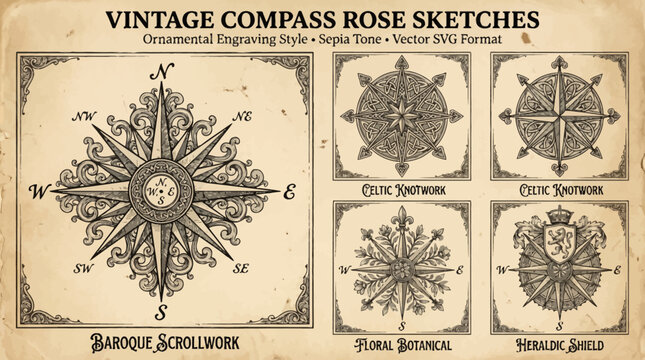
Introduction
The Compass Rose is one of the most recognizable symbols in navigation. You can find it on old maps, modern maps, nautical chart collections, and even digital navigation tools. At first glance, it may look like a decorative design, but it has helped explorers, sailors, travelers, and map readers find their way for hundreds of years.
A Compass Rose shows directions such as North, South, East, and West. It may also include Northeast, Northwest, Southeast, and Southwest, along with many additional compass points. These directions help people understand orientation, determine bearings, and travel safely from one place to another.
Many people confuse the Compass Rose with a magnetic compass, but they are not the same. A magnetic compass is a physical tool with a magnetic needle, while a Compass Rose is a navigation symbol printed on a map or chart. Together, they make navigation much easier.
The Compass Rose is also called a wind rose or rose of the winds. Over time, it has become much more than a simple orientation symbol. It appears in education, architecture, logos, outdoor survival guides, marine navigation, aviation, and even artwork.
This guide explains everything you need to know about the Compass Rose. You will learn its history, different designs, practical uses, connection with maps, role in modern technology, and the fascinating stories behind one of the world’s oldest navigation symbols.
What Is a Compass Rose?
A Compass Rose is a diagram printed on a map or nautical chart that shows directions. It helps people understand where they are and which way they should travel. Whether you are reading a road map, hiking trail, or sea chart, the Compass Rose provides a quick reference for orientation.
The center of the Compass Rose usually represents your current position. Around it are the cardinal directions, North, South, East, and West. Many designs also include intercardinal directions, sometimes called intermediate directions, such as Northeast and Southwest.
Some Compass Roses include many more compass points. Older maritime maps often displayed sixteen or even thirty-two directions to help sailors travel more accurately across large oceans.
The Compass Rose works together with navigation tools like a magnetic compass. By matching the compass needle with the directions shown on the map, travelers can determine the correct path and follow accurate compass bearings.
Although modern GPS systems have simplified navigation, the Compass Rose remains one of the easiest ways to understand geographic orientation. Students, hikers, sailors, surveyors, and pilots still learn how to use it because it builds strong navigation skills.
The symbol is also useful because it is universal. No matter what language a person speaks, the Compass Rose provides a clear visual guide for direction.
How the Compass Rose Evolved Over Time
The story of the Compass Rose begins long before modern maps existed. Early travelers depended on the sun, stars, mountains, rivers, and coastlines to find their way. As trade expanded, people needed more reliable methods of navigation.
Ancient civilizations gradually developed simple direction systems. Sailors carefully observed seasonal winds and created what later became known as the wind rose. Instead of using only four directions, they identified many wind patterns that helped guide ships across the sea.
During the Middle Ages, European mapmakers improved these systems by creating detailed portolan charts. These charts included carefully drawn Compass Roses connected by lines that represented sailing directions. They became essential tools for merchants and explorers.
Many historians connect the development of improved navigation with Italy, especially the maritime city of Amalfi. Traditional stories often mention Flavio Gioia as someone associated with improvements to the magnetic compass, although historians continue to debate the exact details.
As maritime trade expanded, the Compass Rose became more detailed. Sailors traveling between Europe, Asia, and the Middle East relied on these maps to follow trade routes safely. The symbol eventually spread across the world.
The Compass Rose continued evolving during the Age of Exploration. Better cartography allowed mapmakers to produce increasingly accurate world maps. Explorers crossing oceans depended on the combination of the Compass Rose, magnetic compass, and celestial navigation.
Today, although digital maps use satellite technology, the basic design of the Compass Rose remains almost unchanged. It continues to represent centuries of exploration, scientific progress, and human curiosity.
Why the Compass Rose Matters in Navigation
Navigation is simply the process of finding the correct path from one place to another. The Compass Rose plays an important role because it provides a fixed reference for direction.
Imagine standing in the middle of a forest with a paper map. Without knowing where north is located, the map becomes difficult to use. The Compass Rose solves this problem by showing the relationship between the map and the real world.
For sailors using a nautical chart, accurate direction is even more important. A small mistake can cause a ship to travel many miles away from its intended route. The Compass Rose helps mariners maintain correct bearings while crossing open water.
Pilots also depend on direction systems. Although aircraft use advanced electronic equipment, pilots still understand the principles behind the Compass Rose because navigation always begins with knowing direction.
Outdoor enthusiasts benefit as well. Campers, hikers, mountain climbers, and survival experts regularly practice using maps together with a Compass Rose. If electronic devices lose power, these traditional skills remain valuable.
Even everyday drivers use ideas connected to the Compass Rose. Many digital navigation systems quietly rely on directional references that began with traditional compass designs.
The Compass Rose therefore represents much more than a drawing. It is one of the foundations of modern navigation and continues to support travel across land, sea, and air.
Understanding Compass Rose Directions
The Compass Rose begins with four cardinal directions:
- North
- South
- East
- West
These four directions divide the world into simple sections and provide the basic framework for navigation.
Between each cardinal direction are the intercardinal directions:
- Northeast
- Northwest
- Southeast
- Southwest
These additional directions provide greater accuracy. For example, instead of walking directly north, you might travel northeast toward your destination.
More detailed Compass Roses include sixteen directions. These add points such as North-Northeast and East-Southeast, allowing travelers to describe movement much more precisely.
The most advanced traditional design contains thirty-two-point compass rose markings. These were especially useful during the age of sailing when precise direction determined whether ships reached their destinations safely.
Professional navigators also use degrees. A complete circle contains 360 degrees. North represents 0° or 360°, East is 90°, South is 180°, and West is 270°. Every other direction falls somewhere between these values.
Learning these directions also introduces the traditional skill known as boxing the compass, where navigators memorize every compass point in order. This practice improves navigation speed and accuracy.
Understanding Compass Rose directions is the first step toward mastering map reading and outdoor navigation.
Different Types of Compass Rose Designs
Not every Compass Rose looks the same. Different designs were created for different purposes throughout history.
The simplest version is the four-point compass rose. It displays only North, South, East, and West. This design is common in children’s maps and simple diagrams because it is easy to understand.
The next level is the eight-point compass rose, which adds the four diagonal directions. This version provides greater accuracy and appears on many educational maps.
The sixteen-point compass rose offers even more precision. It introduces additional intermediate directions that help sailors and navigators maintain exact travel paths.
Professional maritime charts often display the thirty-two-point compass rose. Every point represents a small change in direction, allowing ships to navigate safely over long distances.
Modern navigation systems sometimes use a 360-degree compass rose, where every direction is measured numerically instead of by name. This method is common in aviation, surveying, engineering, and military navigation.
Many historic Compass Roses also include beautiful artistic details. One famous feature is the Fleur-de-lis, which traditionally marks north. This decorative symbol made maps both useful and visually attractive.
Some historical maps even included colorful wind names, decorative patterns, and symbols representing important regions such as Jerusalem, which appeared at the center of certain medieval maps because of its religious importance.
Although technology continues to advance, these classic Compass Rose designs remain valuable educational tools that demonstrate how navigation has developed over time.
Compass Rose vs. Magnetic Compass
Many beginners think the Compass Rose and a magnetic compass are the same object. They are closely related, but they perform different jobs.
A Compass Rose is a printed compass diagram or orientation symbol found on maps and nautical charts. It never moves. Its purpose is to show directions and help users understand map orientation.
A magnetic compass is a physical instrument. Inside it is a magnetic needle that naturally points toward magnetic north because of Earth’s magnetic field. Travelers use this device to determine their direction while moving.
The two tools work together. Imagine using a hiking map. First, you identify north on the Compass Rose. Next, you align your magnetic compass with the map until both north indicators match. Once aligned, you can follow the correct compass bearings toward your destination.
Historically, sailors depended on both tools during long sea journeys. The Compass Rose provided the directional framework, while the magnetic compass supplied real-time heading information.
One important part of the magnetic compass is the lodestone, a naturally magnetic mineral that inspired the earliest compass technology. Ancient scientists discovered that lodestones could align with Earth’s magnetic field, leading to the development of the first practical compasses.
Understanding the difference between these two tools helps beginners avoid confusion. The Compass Rose explains direction on the map, while the magnetic compass tells you which direction you are actually facing in the real world.
True North vs. Magnetic North
One of the most important lessons in navigation is understanding the difference between True North and Magnetic North. These two terms sound similar, but they are not the same.
True North is the direction toward the geographic North Pole. It is based on the Earth’s axis, the imaginary line around which our planet rotates. Maps and geographic coordinates are usually created using True North because it stays in the same location.
Magnetic North, on the other hand, is the point that a magnetic compass points toward. This location is controlled by the Earth’s magnetic field, which slowly changes over time. Because of this movement, Magnetic North does not stay in exactly the same place every year.
The difference between these two directions is called magnetic declination or compass variation. In some places, the difference is very small. In others, it can be several degrees. If a traveler ignores this difference during a long journey, they may end up far from their intended destination.
There is also another term called compass deviation. Unlike magnetic declination, deviation is caused by nearby metal objects, electronic equipment, or the structure of a vehicle or ship. This can temporarily affect the accuracy of a compass.
Modern GPS devices automatically calculate location using satellites, but experienced navigators still understand the relationship between True North and Magnetic North. Hikers, sailors, surveyors, pilots, and military professionals often learn both methods so they can navigate safely if electronic systems fail.
Knowing the difference between these two reference points improves navigation accuracy and helps people make better decisions when reading maps or following compass headings.
How to Read a Compass Rose
Learning to read a Compass Rose is much easier than many people think. Once you understand the basic directions, the symbol becomes a simple guide that helps you travel with confidence.
Start by locating the north arrow on the Compass Rose. Many traditional designs mark north with a decorative Fleur-de-lis, making it easy to identify. Once you know where north is, every other direction naturally falls into place.
Next, identify the cardinal directions: North, South, East, and West. These divide the map into four equal sections. Then look for the intercardinal directions, such as Northeast and Southwest, which provide more precise orientation.
If your map includes a sixteen-point compass rose or a thirty-two-point compass rose, you will notice many additional direction labels. These allow navigators to describe movement with much greater accuracy.
Now place your magnetic compass on the map. Rotate the map until the compass needle points toward north on the Compass Rose. This process aligns the map with the real world.
Once everything is aligned, you can determine bearings, estimate travel direction, and plan the safest route. Whether hiking through a forest or sailing across the ocean, the Compass Rose helps you stay on course.
Practicing with simple maps is the best way to build confidence. Over time, reading a Compass Rose becomes almost automatic.
Using a Compass Rose on Maps
A Compass Rose is one of the most useful parts of any map because it explains the map’s orientation. Without it, users might easily confuse directions and choose the wrong route.
Imagine planning a hiking trip. Before you begin walking, you examine the map and locate the Compass Rose. By identifying north, you can compare the map with the actual landscape around you.
This process also helps during map reading. Roads, rivers, mountains, and trails become much easier to understand when you know which direction they travel.
On a nautical chart, the Compass Rose plays an even more important role. Sailors use it together with compass bearings to steer ships safely through open water. A small mistake in direction can become a large error after many miles of travel.
Pilots also use directional information while planning flights. Although aircraft rely on advanced technology, understanding map orientation remains an important navigation skill.
Surveyors, engineers, rescue teams, and military personnel regularly use Compass Roses during field operations. These professionals often combine paper maps with electronic systems to improve reliability.
Even modern apps such as digital maps continue using Compass Rose principles. While users may only see a small direction icon, the same navigation concepts remain at work behind the scenes.
Modern Uses of the Compass Rose
Although satellites and smartphones have changed navigation, the Compass Rose remains highly useful today. Its simple design continues to appear in many modern technologies and professions.
Digital mapping services often include a Compass Rose or directional arrow that rotates as users change direction. This makes navigation easier when walking, driving, or cycling.
Marine navigation still depends heavily on Compass Rose principles. Ships use electronic navigation systems, but captains continue learning traditional navigation because equipment can sometimes fail.
In aviation, pilots use headings based on compass directions and degrees. While computers assist with navigation, understanding directional systems remains part of flight training.
Outdoor recreation also keeps the Compass Rose relevant. Hikers, campers, mountain climbers, hunters, and survival experts often carry maps and compasses as backup tools. Batteries can run out, but a paper map never loses power.
Surveyors use Compass Rose concepts when measuring land and preparing property maps. Engineers rely on directional references when planning roads, bridges, and construction projects.
Military navigation also depends on accurate direction. Soldiers learn map reading, compass use, and navigation skills before relying on electronic equipment.
The Compass Rose has even become a popular design in architecture, public parks, floor mosaics, monuments, jewelry, tattoos, and logo design. Its combination of beauty and meaning makes it both practical and decorative.
These modern applications prove that the Compass Rose continues serving people in many different ways, even in the digital age.
Compass Rose Symbols and Hidden Meanings
The Compass Rose is more than a navigation tool. It also contains rich symbolism that reflects centuries of exploration, discovery, and hope.
One of its best-known features is the Fleur-de-lis, which traditionally marks north. Historians believe this symbol became popular because it was easy to recognize and added elegance to maps.
Earlier versions of the Compass Rose were known as the wind rose or rose of the winds because sailors relied on seasonal wind patterns for travel. Each direction often represented a particular wind that influenced sea routes.
The Compass Rose also symbolizes guidance. Many people see it as a reminder to stay focused, make wise decisions, and keep moving toward their goals. Because of this meaning, it is commonly used in artwork, home decorations, and tattoos.
Some medieval maps placed Jerusalem at the center rather than focusing only on geography. This reflected the religious beliefs of the time and showed how maps often combined navigation with cultural values.
The history of cartography demonstrates that mapmakers wanted their work to be both useful and beautiful. Decorative Compass Roses, colorful illustrations, and artistic lettering turned maps into works of art as well as practical navigation tools.
The Compass Rose also reminds us of humanity’s desire to explore. Ancient mariners crossed unknown seas using little more than simple maps, stars, and a magnetic compass. Their courage helped connect continents through trade routes and cultural exchange.
Today, the symbol still represents adventure, curiosity, leadership, and the confidence to move forward. Whether displayed on a map, carved into stone, or worn as jewelry, the Compass Rose continues inspiring people around the world.
Compass Rose in Education and Outdoor Skills
The Compass Rose is an excellent teaching tool because it combines geography, science, mathematics, and history in one simple diagram. Students often learn about cardinal directions, intercardinal directions, and map reading at an early age. These lessons build important life skills that can be used both inside and outside the classroom.
Teachers frequently use maps with a Compass Rose to explain geographic orientation. Students learn how to locate places, describe directions, and understand how maps represent the real world. Activities such as finding the shortest route between two locations help children practice problem-solving while improving their navigation skills.
A Compass Rose also supports lessons in mathematics. Students can measure angles, understand 360-degree compass rose systems, and calculate simple bearings. For example, if a traveler moves from North to East, they have turned 90 degrees. These practical examples make abstract math concepts easier to understand.
Outdoor education programs often include navigation exercises. Students receive a paper map, a magnetic compass, and a destination. They learn how to align the compass with the Compass Rose, follow compass bearings, and safely reach their goal. These exercises build confidence while encouraging teamwork and careful observation.
Camping and hiking groups also teach traditional navigation. While smartphones and GPS devices are helpful, batteries can fail or signals can disappear. Knowing how to use a Compass Rose with a map provides a reliable backup method in remote areas.
Parents can introduce younger children to the Compass Rose through games. Treasure hunts, neighborhood walks, and simple direction challenges make learning fun. Asking questions such as “Which direction is the park?” or “Walk five steps east” helps children remember directions naturally.
The Compass Rose also encourages curiosity about the world. Students often become interested in exploration, maritime history, cartography, and geography after learning how people navigated long before satellites and digital maps existed.
Interesting Facts About the Compass Rose
The Compass Rose has a long and fascinating history filled with interesting facts. Although it is now common on maps, its design has changed many times over the centuries.
One of the earliest forms was called the wind rose because sailors identified directions using seasonal winds instead of modern compass systems. These wind names helped ships travel safely across the Mediterranean Sea and other important trade routes.
Many historic maps featured beautifully decorated Compass Roses. Mapmakers added colorful artwork, detailed patterns, and symbols to make their maps attractive as well as useful. Some of these maps are now displayed in museums around the world.
The famous Fleur-de-lis has traditionally marked north on many Compass Roses. Its elegant design helped navigators quickly identify the correct direction without confusion.
During the Middle Ages, portolan charts became some of the most accurate navigation tools available. These charts included large Compass Roses connected by navigation lines that guided sailors between ports.
The traditional thirty-two-point compass rose allowed experienced mariners to describe direction with impressive accuracy. Long before electronic navigation existed, these detailed direction systems helped ships complete long ocean voyages.
Some historical accounts connect improvements in navigation with Amalfi and Flavio Gioia. While historians continue discussing the exact details, these stories remain an important part of navigation history.
Today, the Compass Rose appears in textbooks, museums, architecture, public monuments, logos, jewelry, and artwork. Its simple design continues to inspire people because it represents guidance, discovery, and exploration.
Common Mistakes When Reading a Compass Rose
Although the Compass Rose is easy to understand, beginners sometimes make mistakes that can lead to navigation errors.
One common mistake is confusing the Compass Rose with a magnetic compass. The Compass Rose is a printed compass diagram, while the magnetic compass is the tool that points toward Magnetic North. Understanding this difference is essential for accurate navigation.
Another mistake is forgetting the difference between True North and Magnetic North. Because of magnetic declination, these directions are not always the same. Ignoring this difference can cause navigation errors, especially during long journeys.
Some people also forget to align the map correctly before beginning their trip. If the map is rotated the wrong way, every direction becomes confusing. Always match the compass needle with north on the Compass Rose before following a route.
Another frequent error is overlooking the intercardinal directions. Beginners often focus only on North, South, East, and West, even when their destination lies Northeast or Southwest. Learning all major directions improves navigation accuracy.
People sometimes misunderstand bearings as well. A bearing is measured in degrees from north, not simply by looking at a direction label. Practicing with simple maps helps users become comfortable with this system.
Finally, many travelers depend completely on electronic devices. GPS technology is very reliable, but batteries can fail or signals can be interrupted. Knowing how to use a Compass Rose and a paper map provides an important backup that can improve safety during outdoor adventures.
Avoiding these common mistakes makes navigation easier and helps people build confidence when exploring unfamiliar places.
Conclusion
The Compass Rose has guided people for centuries, from ancient sailors crossing open seas to modern travelers using digital maps. Although technology has changed dramatically, the basic purpose of the Compass Rose remains the same. It helps people understand direction, maintain orientation, and travel safely.
Throughout history, the Compass Rose has evolved from the early wind rose into one of the world’s most recognized navigation symbols. It has supported explorers, merchants, mariners, surveyors, pilots, hikers, and students while contributing to the growth of cartography, geography, and navigation science.
Learning about the Compass Rose also teaches important life skills. Understanding cardinal directions, intercardinal directions, bearings, True North, and Magnetic North improves map-reading ability and builds confidence in outdoor environments. Even in an age of GPS and smartphones, these traditional skills remain valuable.
Beyond navigation, the Compass Rose represents exploration, curiosity, and the courage to discover new places. Its appearance in maps, architecture, education, artwork, and public spaces reminds us that finding the right direction has always been an important part of human history.
Whether you are reading a nautical chart, planning a hiking trip, studying geography, or simply appreciating its beautiful design, the Compass Rose continues to serve as both a practical tool and a timeless symbol of guidance.
FAQs
1. What is a Compass Rose?
A Compass Rose is a diagram on a map or nautical chart that shows directions such as North, South, East, and West. It helps people understand orientation and navigate accurately.
2. Why is it called a Compass Rose?
It is called a Compass Rose because early versions resembled the petals of a flower and were closely connected to the wind rose, which represented important wind directions used by sailors.
3. What is the difference between a Compass Rose and a magnetic compass?
A Compass Rose is a printed symbol on a map, while a magnetic compass is a physical instrument with a magnetic needle that points toward Magnetic North.
4. What are the four main directions on a Compass Rose?
The four cardinal directions are North, South, East, and West.
5. What are intercardinal directions?
The intercardinal directions are Northeast, Northwest, Southeast, and Southwest. They provide more accurate direction between the four main compass points.
6. What is the difference between True North and Magnetic North?
True North points toward the geographic North Pole, while Magnetic North is where a magnetic compass points because of Earth’s magnetic field.
7. What are the different types of Compass Rose designs?
The most common designs include the four-point compass rose, eight-point compass rose, sixteen-point compass rose, thirty-two-point compass rose, and modern 360-degree compass rose systems.
8. Where is the Compass Rose used today?
It is used in maps, marine navigation, aviation, surveying, education, hiking, camping, military navigation, digital mapping applications, and outdoor survival training.
9. What does the Fleur-de-lis mean on a Compass Rose?
The Fleur-de-lis traditionally marks north on many Compass Rose designs, making it easy for users to identify the correct direction.
10. Why is learning the Compass Rose still important?
Learning the Compass Rose improves map-reading skills, supports safe navigation, develops geographic knowledge, and provides a reliable backup when electronic navigation systems are unavailable.