Equipment failure can disrupt an entire business operation. A damaged motor can stop a production line. A faulty pump can delay an industrial process. Even a small machine problem can lead to expensive repairs and missed deadlines.
Businesses have traditionally relied on scheduled maintenance or repairs after equipment breaks down. However, these approaches do not always identify problems early enough. AI-powered digital twins offer a more informed way to monitor equipment and predict possible failures.
Companies are already exploring AI in business automation to reduce repetitive work and improve operational decisions. Digital twins take this approach further by creating virtual models of physical machines. These models use real-time information to show how equipment performs under actual operating conditions.
When combined with machine learning and autonomous AI agents, digital twins can help maintenance teams identify unusual patterns and decide when equipment needs attention. This also connects with the growing use of AI tools for software development, which support the development of intelligent monitoring platforms and industrial applications.
The result is a shift from reacting to equipment problems toward identifying warning signs before they become serious failures.
What Are AI-Powered Digital Twins?
A digital twin is a virtual representation of a physical object, machine, process, or complete system. It uses data from the real-world asset to reflect its current condition and behavior.
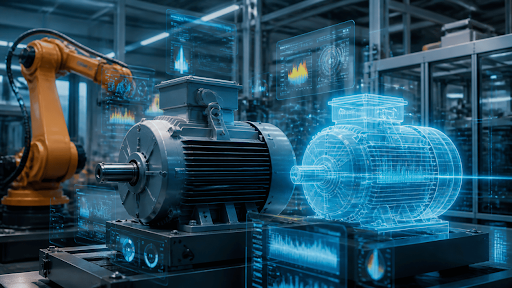
For example, consider an industrial electric motor operating inside a manufacturing facility. Sensors attached to the motor collect information about temperature, vibration, speed, pressure, and energy consumption.
This information reaches its digital twin through connected systems. The virtual model then represents the motor’s operating condition and helps engineers understand how it behaves.
Artificial intelligence adds another layer to this process. Machine learning models study historical and current data to identify patterns that may indicate equipment problems.
A digital twin can therefore help businesses answer important questions:
- Is the machine operating within normal limits?
- Are temperature or vibration levels changing?
- Does the equipment show signs of unusual wear?
- Which component may require inspection?
- How much operating life might remain before maintenance is necessary?
Unlike a basic 3D model, an AI-powered digital twin works with changing operational data. It can support continuous monitoring, fault detection, and maintenance planning.
Research published in the Journal of Manufacturing Systems also highlights how AI-enhanced digital twins combine physical assets, data transmission, virtual models, AI analytics, and maintenance services.
DOI+1
How Digital Twins Predict Equipment Failures
Predicting equipment failure requires more than collecting sensor readings. Businesses need systems that can understand changing conditions and connect unusual patterns with possible technical problems.
AI-powered digital twins combine several technologies to make this possible.
1. Collecting Real-Time Equipment Data
The process starts with sensors installed on physical equipment.
These sensors continuously collect operational information, including:
- Temperature and heat levels
- Machine vibration
- Operating speed
- Pressure changes
- Electrical current
- Energy consumption
- Noise and acoustic signals
For instance, an industrial motor may normally operate within a particular temperature range. If its temperature gradually increases, the system can identify this change.
A single reading may not indicate a serious problem. However, repeated increases combined with unusual vibration could suggest a developing mechanical fault.
The digital twin receives these readings and updates its virtual representation accordingly.
2. Creating a Virtual Equipment Model
Once the data becomes available, the digital twin uses it to represent the physical machine.
Engineers can examine its operating condition without relying only on manual inspections.
The virtual model can represent:
- Machine components
- Operating conditions
- Performance levels
- Equipment history
- Current sensor readings
- Changes in machine behavior
This helps maintenance teams understand how different components work together.
For example, a manufacturing plant may operate several industrial pumps. Each pump can have its own digital twin, allowing engineers to compare performance and identify machines that require attention.
3. Using Machine Learning to Identify Unusual Patterns
Machine learning helps digital twins understand equipment behavior.
The system studies historical maintenance records and sensor readings. It learns which patterns are associated with normal operation and which may indicate a developing fault.
Common machine learning techniques include:
- Random Forest
- Support Vector Machines
- Neural Networks
- Long Short-Term Memory Networks
- Gradient Boosting
Suppose a machine usually operates with stable vibration levels. Over several days, its vibration readings begin increasing.
An AI model can compare this pattern with previous equipment data. It may identify similarities with earlier bearing failures or mechanical imbalances.
The system can then flag the machine for inspection.
The prediction depends on data quality, model accuracy, and the operating conditions used during training. AI does not guarantee that every failure will be detected.
4. Estimating Remaining Useful Life
One important application of predictive maintenance is Remaining Useful Life (RUL) estimation.
RUL refers to the estimated time an equipment component can continue operating before it reaches a defined failure condition or requires replacement.
For example, an industrial bearing may show gradual wear. By studying vibration patterns, operating hours, temperature, and previous maintenance records, an AI model can estimate how much useful life remains.
Maintenance teams can use this information to plan replacement work.
They do not need to replace every component based on a fixed calendar. Instead, they can consider its actual condition and predicted performance.
However, RUL estimates are not exact deadlines. Operating conditions and unexpected events can change the actual lifespan of a component.
Key Applications of AI-Powered Digital Twins Across Industries
Digital twin technology is not limited to manufacturing. Businesses in several industries can use virtual models to monitor assets, understand performance, and plan maintenance.
Manufacturing and Industrial Production
Manufacturing facilities depend on machines that must operate consistently. A failure in one production unit can affect several connected processes.
AI-powered digital twins help manufacturers monitor:
- Industrial motors and generators
- Conveyor belt systems
- Robotic manufacturing equipment
- CNC machines
- Production lines
- Hydraulic and pneumatic systems
For example, a digital twin can monitor a CNC machine’s vibration and temperature. If the readings begin changing, the system can alert engineers before the machine develops a major fault.
This gives maintenance teams time to inspect components and arrange repairs without waiting for production to stop.
Energy and Power Generation
Power plants depend on turbines, generators, transformers, and other expensive equipment.
Unexpected failures can interrupt electricity generation and increase operating costs.
Digital twins help energy companies monitor equipment performance and identify unusual operating conditions.
A turbine’s virtual model can use temperature, pressure, vibration, and rotational speed data. AI models can compare these readings with historical patterns and highlight possible mechanical problems.
Engineers can also use simulations to understand how equipment might respond to different operating conditions.
Healthcare and Medical Equipment
Hospitals depend on medical equipment that must remain reliable.
MRI machines, CT scanners, ventilators, and laboratory systems require regular inspections and maintenance.
Digital twins can help healthcare facilities monitor equipment performance and identify potential maintenance requirements.
For example, a hospital could use connected sensors to monitor the operating temperature and performance of critical equipment.
This allows technical teams to investigate unusual readings before equipment becomes unavailable.
Digital twin technology does not replace medical equipment safety checks or manufacturer maintenance requirements. It supports better equipment management.
Transportation and Logistics
Transportation businesses manage large fleets of vehicles, warehouse equipment, and distribution systems.
Unexpected breakdowns can delay deliveries and affect customer commitments.
Digital twins can help monitor vehicle components, engine performance, fuel consumption, and operating conditions.
For example, a logistics company can create digital models of its delivery vehicles. The system can analyze engine temperature, mileage, vibration, and maintenance records.
If a vehicle begins showing unusual performance patterns, the maintenance team can arrange an inspection before its next long-distance journey.
This approach can also help businesses plan vehicle servicing across multiple locations.
Oil, Gas, and Heavy Engineering
Oil and gas operations depend on complex machinery working under demanding conditions.
Pipelines, compressors, pumps, drilling equipment, and pressure systems require continuous monitoring.
AI-powered digital twins can help engineers examine equipment conditions and identify possible operational risks.
They can also simulate different pressure and temperature conditions. This allows technical teams to study how equipment may respond before making operational changes.
For businesses working with expensive industrial assets, early fault identification can support safer and more organized maintenance planning.
Digital Twins vs Traditional Preventive Maintenance
Traditional preventive maintenance follows a predetermined schedule. Businesses inspect or replace components after specific operating hours or calendar intervals.
Predictive maintenance takes a different approach. It uses actual equipment conditions and data to determine when maintenance may be necessary.
Here is how the two approaches differ.
| Factor | Traditional Preventive Maintenance | AI-Powered Predictive Maintenance |
| Maintenance timing | Fixed schedule | Based on equipment condition |
| Data usage | Limited operational data | Continuous sensor information |
| Failure identification | Scheduled inspections | AI-based anomaly detection |
| Equipment monitoring | Periodic | Near real-time |
| Maintenance planning | Calendar-based | Prediction-based |
| Decision support | Maintenance history | Data, analytics, and simulations |
Neither approach is suitable for every situation. Some equipment still requires mandatory scheduled inspections and servicing.
However, predictive maintenance adds another layer of information. Businesses can combine both methods to make maintenance decisions more practical.
Major Benefits of AI-Powered Digital Twins
The value of digital twins goes beyond identifying equipment problems. They can improve how businesses manage assets, employees, and maintenance budgets.
Reduced Unplanned Downtime
Unexpected equipment failures can stop operations without warning.
Digital twins help maintenance teams identify unusual behavior before it develops into a serious problem.
Early alerts give businesses more time to investigate and schedule repairs.
This can reduce avoidable production interruptions.
Better Maintenance Planning
Maintenance teams often manage several machines and competing service requirements.
Without accurate information, deciding which machine needs attention first can become difficult.
Digital twins provide information about equipment condition and potential risks.
Managers can use these insights to prioritize inspections, arrange spare parts, and assign technicians.
Improved Equipment Lifespan
Operating equipment beyond its recommended limits can increase wear and damage.
Digital twins help engineers understand how machines behave under different operating conditions.
They can identify performance changes and support decisions about component replacement.
Regular monitoring and timely maintenance can help businesses protect expensive equipment.
Lower Maintenance Costs
Unexpected breakdowns often require urgent repairs, replacement components, and additional labor.
They can also create production losses.
Predictive maintenance helps businesses identify potential problems earlier. This gives maintenance teams more time to plan repairs and manage resources.
The actual savings depend on equipment type, implementation costs, and the accuracy of the prediction system.
Better Operational Decisions
Digital twins give managers a clearer picture of equipment performance.
Instead of relying only on maintenance reports, they can examine current readings, historical trends, and simulation results.
This supports better decisions about equipment replacement, production schedules, and maintenance investments.
Technologies That Make AI Digital Twins Work
AI-powered digital twins depend on several technologies working together. Each technology performs a different role.
Industrial Internet of Things (IIoT)
IIoT connects industrial machines and sensors to digital systems.
Sensors collect information from physical equipment and transmit it to monitoring platforms.
Without reliable data collection, a digital twin cannot accurately represent the machine’s condition.
Artificial Intelligence and Machine Learning
AI processes equipment data and identifies patterns.
Machine learning models can detect unusual behavior, classify potential faults, and estimate remaining useful life.
The quality of predictions depends on training data and how closely the model reflects actual operating conditions.
Cloud Computing
Cloud platforms provide storage and computing resources for digital twin systems.
Businesses can store historical sensor readings, process large datasets, and access equipment information across different locations.
Cloud infrastructure is particularly useful for companies managing multiple facilities.
Edge Computing
Not every industrial decision should depend on sending data to a distant cloud server.
Edge computing processes information closer to the equipment.
This can reduce delays when monitoring systems need to identify abnormal conditions quickly.
A hybrid edge-cloud architecture can combine local processing with centralized analysis.
Data Analytics and Visualization
Dashboards help engineers understand information generated by digital twins.
They can view equipment performance, temperature changes, vibration levels, alerts, and maintenance history.
Clear visual information makes it easier to investigate problems and communicate maintenance requirements.
Recent research also demonstrates how digital twin systems can combine sensor monitoring, machine learning, and edge computing for equipment failure prediction.
DOI+1
Challenges Businesses Must Consider Before Implementation
Although AI-powered digital twins offer practical benefits, implementation requires careful planning.
Businesses should understand the technical and operational challenges before investing in this technology.
1. High Initial Implementation Costs
Developing a digital twin requires sensors, software, data infrastructure, and technical expertise.
Businesses may also need to upgrade older machines before connecting them to modern monitoring systems.
For smaller manufacturers, these initial expenses can become a major concern.
A practical approach is to begin with one critical machine or production unit.
2. Poor Data Quality
AI models depend on reliable information.
Incorrect sensor readings, missing records, and inconsistent data can affect prediction accuracy.
Businesses should regularly inspect sensors and maintain accurate equipment records.
They should also establish processes for cleaning and validating incoming data.
3. Integration With Existing Systems
Many industrial facilities use older equipment and software.
Connecting these systems with modern digital twin platforms can require additional development work.
Businesses may need suitable APIs, communication protocols, and data integration tools.
A clear integration plan helps avoid unnecessary technical complications.
4. Cybersecurity and Data Protection
Connected industrial equipment creates additional security requirements.
Unauthorized access to monitoring platforms could expose operational information or affect industrial systems.
Businesses should consider:
- Strong authentication
- Role-based access controls
- Data encryption
- Network segmentation
- Regular security updates
- Continuous system monitoring
Security should be considered during the design stage rather than added after deployment.
5. Shortage of Skilled Professionals
Digital twin projects require knowledge of industrial engineering, data analytics, machine learning, and software development.
Not every business has these skills available internally.
Training existing employees and working with experienced technology partners can help close this gap.
How Businesses Can Start Using AI-Powered Digital Twins
Businesses do not need to create digital twins for every machine immediately. A gradual implementation can help them understand the technology and measure its value.
Here is a practical approach.
Step 1: Identify Critical Equipment
Start with machines where unexpected failures create significant operational problems.
Consider production equipment, industrial motors, pumps, generators, and expensive machinery.
Step 2: Define Maintenance Objectives
Decide what the business wants to improve.
Possible objectives include reducing downtime, identifying faults earlier, extending equipment life, or improving maintenance schedules.
Step 3: Install Suitable Sensors
Choose sensors according to the equipment being monitored.
Temperature sensors, vibration sensors, pressure sensors, and electrical monitoring devices can provide useful operational information.
Step 4: Build the Digital Twin
Create a virtual representation of the selected equipment.
Connect it with the required sensor data and existing operational systems.
Step 5: Integrate AI Models
Use suitable machine learning models to analyze equipment performance.
Train them using historical maintenance records and operational data.
Step 6: Test Predictions
Compare AI predictions with actual equipment conditions.
Maintenance engineers should verify alerts and identify inaccurate predictions before depending on the system for important decisions.
Step 7: Expand Gradually
Once the initial implementation delivers useful results, businesses can expand digital twin monitoring to additional equipment and facilities.
The Future of AI-Powered Digital Twins
Digital twin technology is moving beyond basic equipment monitoring.
Future systems are expected to combine more advanced AI models, real-time simulations, and automated decision support.
Several developments are worth watching.
Autonomous Maintenance Systems
AI agents may increasingly support maintenance workflows.
They could analyze equipment alerts, review maintenance records, prepare work orders, and recommend suitable inspection procedures.
Human engineers would still review important decisions and approve physical maintenance activities.
More Accurate Failure Predictions
Improvements in machine learning can help systems understand complex equipment behavior.
Models may combine vibration, temperature, pressure, and historical failure information to provide better predictions.
However, accuracy will still depend on reliable data and real-world testing.
Digital Twins Across Entire Factories
Instead of creating separate digital models for individual machines, businesses may connect multiple twins into one operational environment.
This could help managers understand how a problem in one machine affects an entire production line.
Integration With Robotics and Automation
Digital twins can also support industrial robotics.
Engineers may simulate robotic operations, test changes, and study equipment behavior before applying modifications to physical systems.
This can make production planning and equipment management more informed.
Greater Use of Edge AI
Processing information closer to industrial equipment can support faster monitoring and fault detection.
Edge AI may become particularly useful in environments where internet connectivity is limited or immediate responses are important.
Conclusion
AI-powered digital twins are changing how businesses approach equipment maintenance. Instead of waiting for machines to break down, companies can use real-time data and machine learning to identify warning signs earlier.
From manufacturing plants to energy facilities and logistics operations, this technology offers practical ways to monitor equipment and improve maintenance planning.
However, successful implementation requires reliable sensors, quality data, suitable AI models, and proper system integration.
Businesses should start with critical equipment, test their predictions, and expand gradually. Digital twins will not eliminate every equipment failure. They can, however, give maintenance teams better information before problems become expensive disruptions.
As AI, Industrial IoT, and edge computing continue to develop, digital twins are likely to become an important part of modern industrial operations.
Frequently Asked Questions (FAQs)
1. What are AI-powered digital twins?
AI-powered digital twins are virtual representations of physical machines or systems. They use real-time data and artificial intelligence to monitor performance, identify unusual patterns, and predict possible equipment problems.
2. How do digital twins predict equipment failures?
Digital twins collect sensor information from physical equipment. Machine learning models analyze this information and compare it with historical operating patterns. When the system identifies unusual behavior, it can alert maintenance teams about potential problems.
3. What is the difference between a digital twin and predictive maintenance?
A digital twin is a virtual representation of physical equipment. Predictive maintenance is a maintenance strategy that uses equipment data to estimate when servicing may be required. Digital twins can support predictive maintenance through simulations and AI-based analysis.
4. Which industries use digital twin technology?
Manufacturing, healthcare, energy, transportation, logistics, oil and gas, and aerospace industries use digital twins for equipment monitoring, simulation, and operational planning.
5. Can small businesses use AI-powered digital twins?
Yes. Small businesses can start with individual machines or critical equipment. They can use connected sensors and suitable software without creating a digital twin for their entire operation.
6. Do digital twins completely prevent equipment failures?
No. Digital twins help identify potential problems, but they cannot guarantee that every failure will be predicted. Unexpected damage, sensor issues, and changing operating conditions can still cause breakdowns.
7. What technologies are required to build an AI-powered digital twin?
Common technologies include Industrial IoT sensors, machine learning, cloud computing, edge computing, data analytics, simulation software, and visualization platforms.